Delimitation Bill 2026: Every state gets 50% more. What changed?
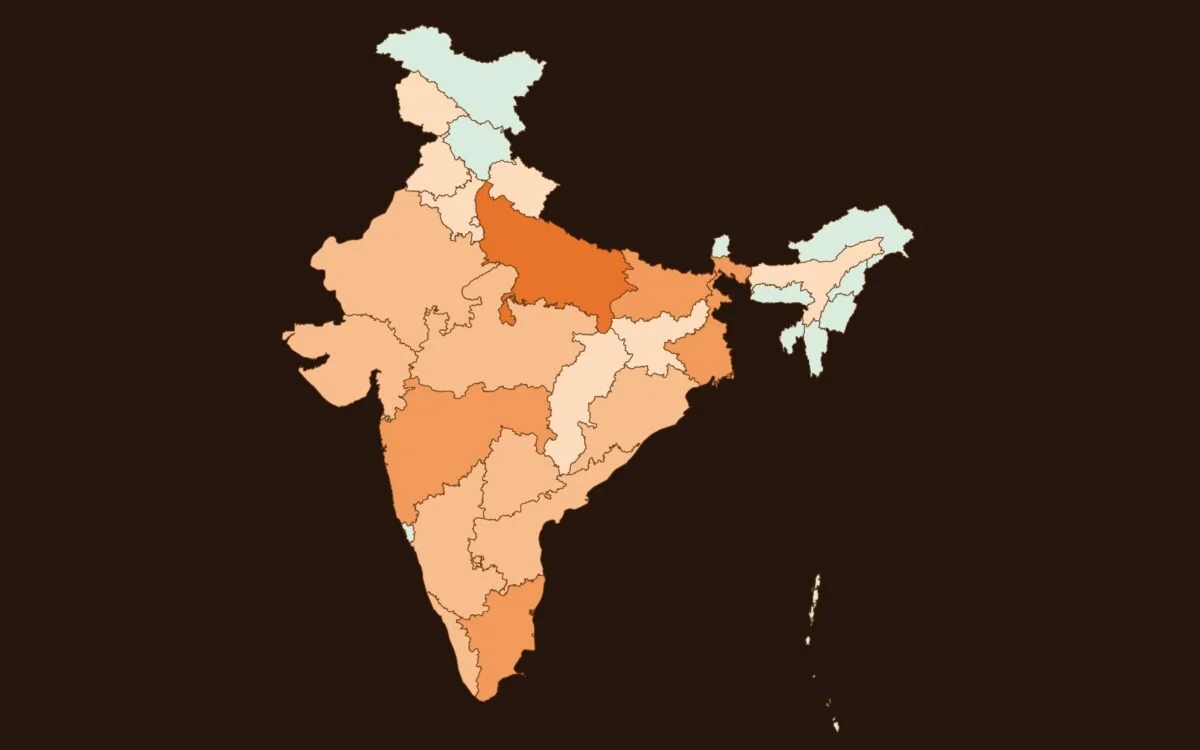
States shaded by current Lok Sabha seats. Graphic: IPB News; boundary data: vardhan-maps/OpenStreetMap (ODbL).
In April, the argument was over which states would lose ground. The Delimitation (Second) Bill, 2026, dated 27 November, answers with a flat rule: every state and Union territory gets 50% more Lok Sabha seats than it has now. That settles the loudest quarrel. It leaves a few others open, including one of plain arithmetic.
The Bill (No. 159 of 2026) is to be introduced by Law Minister Arjun Ram Meghwal. Parliament reconvenes on 30 November. The Bill travels with the Constitution (132nd Amendment) Bill, which the Union Cabinet cleared on Friday.
What the Delimitation Bill does, clause by clause
Clauses 1 and 2: start date and census. The law begins on a date the Centre notifies. “Latest census figures” means those published on that date. Unless 2027 Census results are out by then, that means the 2011 Census.
Also read Women’s Reservation Bill: Special Session Mooted for 20-22 November
Clause 3: a three-member Commission. The Centre must set it up as soon as possible. A serving or former Supreme Court judge chairs it. The other members are the Chief Election Commissioner, or a nominated Election Commissioner, and the State Election Commissioner concerned. The Centre fixes its term and can extend it. A separate provision covers Assembly seats in Pakistan-occupied Jammu and Kashmir, if that area ceases to be occupied.
Clause 4: the job. The Commission reallots Lok Sabha seats, fixes Assembly strengths and redraws constituencies. A state or Union territory with only one seat remains a single constituency.
Clause 5: associate members. Each state gets up to five MPs and five MLAs to assist, nominated by the Speakers. They cannot vote or sign decisions. Assembly Speakers have one month to name them and the Lok Sabha Speaker two. The Commission can also call on the Census Commissioner, the Surveyor General, officials and mapping experts.
Clauses 6 and 7: vacancies and powers. The Commission has civil court powers to summon witnesses and demand records. Decisions go by majority. A vacancy or absence does not invalidate its work.
Clause 8: seats and quotas. The Commission decides seats for each state, those reserved for Scheduled Castes and Scheduled Tribes, and about one-third for women, including SC and ST women. Women’s seats rotate as the Commission sees fit. Each Assembly’s strength must be an exact multiple of that state’s Lok Sabha seats.
Clause 9: drawing the map. Seats should be compact and respect geography, administrative boundaries and public convenience. No Assembly seat may straddle two Lok Sabha seats. Draft proposals are published, objections are invited and public sittings held before final orders. The sub-clause on women’s seats names rotation but sets out no method.
Clause 10: the 50% rule. This overrides the rest of the Act. To bring in women’s reservation at once, each state’s Lok Sabha seats and each state Assembly rise by 50% over their existing numbers.
Clause 11: force of law. Once gazetted, an order has the force of law and “shall not be called in question in any court”. It applies to later elections. The sitting Lok Sabha and Assemblies run their term unchanged, and by-elections follow the old boundaries.
Clauses 12 to 14: housekeeping. The Election Commission may fix errors and update names, but not move boundaries. The new law overrides others on the Commission’s work and repeals the Delimitation Act, 2002.
The financial memorandum says the cost cannot yet be estimated. It will come from the Consolidated Fund of India.
April and November: what is different
The April package failed on 17 April. The Constitution (131st Amendment) Bill got 298 votes in favour and 230 against, short of two-thirds. The Delimitation Bill tied to it went no further.
| Point | April 2026 (Bill No. 108) | November 2026 (Bill No. 159) |
|---|---|---|
| Seats for each state | Reallotted by population; no 50% rule in the text | 50% more for each (clause 10) |
| Women’s reservation | Among the Commission’s duties | Also in the title, with a special clause for immediate effect |
| Setting up the Commission | Centre “may, from time to time” | Centre shall, as soon as may be |
| Census cut-off | Figures published when the Commission is formed | Figures published when the Act commences |
| Length | 13 clauses | 14 clauses |
| Commission, associate members, court bar, repeal of 2002 Act | Provided | Largely carried over |
The linked constitutional amendment matters just as much. April’s version would have let Parliament decide by ordinary law when delimitation happens and which census it uses. It also proposed a Lok Sabha ceiling of 850, with 815 members from states and 35 from Union territories.
The new amendment keeps that ceiling, according to PTI. It also writes in the 50% increase and holds the new allocation until 2051. It raises the maximum size of a state Assembly from 500 to 650. The women’s quota would last 15 years from the start of the 2023 law, unless Parliament extends it. The Delimitation Bill itself says nothing about 2051.
Lok Sabha seats by state: the map
Tap a state. Labels read seats now → proposed (current × 1.5). The Bill does not say how half seats are rounded. Map is indicative and not to scale; boundary data: vardhan-maps, from OpenStreetMap (ODbL).
State by state: who would have got what
The middle column is an estimate by PRS Legislative Research of a House about 50% larger, shared by 2011 population. It shows the direction of April’s approach. It was not a number written into that Bill.
| State | Seats now | Population estimate (April approach) | November Bill (now x 1.5) |
|---|---|---|---|
| Uttar Pradesh | 80 | 133 | 120 |
| Bihar | 40 | 69 | 60 |
| Rajasthan | 25 | 46 | 37.5 |
| Madhya Pradesh | 29 | 48 | 43.5 |
| Maharashtra | 48 | 75 | 72 |
| Gujarat | 26 | 40 | 39 |
| West Bengal | 42 | 61 | 63 |
| Odisha | 21 | 28 | 31.5 |
| Karnataka | 28 | 41 | 42 |
| Tamil Nadu | 39 | 48 | 58.5 |
| Kerala | 20 | 22 | 30 |
| Andhra Pradesh and Telangana | 42 | 56 | 63 |
Across the five southern states, the gap is large: about 167 seats on the population estimate against about 194 under the flat rule. Uttar Pradesh, Bihar, Rajasthan and Madhya Pradesh go the other way, with about 261 instead of 296.
During the April debate, Home Minister Amit Shah had assured the House that the south would not lose, and spoke of its seats rising from 129 to 195. The difference now is that a 50% rule is written into the Bill.
The arithmetic the Bill does not settle
Half seats. Nineteen states and Union territories have an odd number of seats today. Add 50% to Tamil Nadu’s 39 and the answer is 58.5. Rajasthan, Andhra Pradesh, Madhya Pradesh and Telangana hit the same problem. The Bill does not say whether to round up or down. Rounding also decides whether shares stay exactly as they are.
Assembly multiples. Clause 8 wants each Assembly to be an exact multiple of the state’s Lok Sabha seats. Take Rajasthan. Today 200 MLAs sit neatly against 25 MPs, eight to one. After a 50% rise there would be 300 MLAs, which divides by neither 37 nor 38. Our calculation finds the same break in Tamil Nadu, Punjab, Delhi, Odisha, Andhra Pradesh, Telangana and Jammu and Kashmir, all exact multiples today. Clause 10 opens with an override, so the 50% rule would appear to prevail. Parliament could say so plainly.
815 or 850? Half as much again of 543 is about 815. The widely quoted 850 is the constitutional ceiling reported in the amendment, not the figure clause 10 produces. One-third of about 815 is roughly 272 seats for women.
Equal share, unequal weight
A uniform rise protects each state’s slice of the House. It also keeps the old imbalance, because the slices still rest on the 1971 Census. Using 2011 Census population and the new seat numbers, one MP would represent about 18.3 lakh people in Rajasthan, 17.3 lakh in Bihar and 16.7 lakh in Uttar Pradesh. The figure would be about 12.3 lakh in Tamil Nadu and 11.1 lakh in Kerala.
Southern states argue they should not be penalised for slowing population growth. The case on the other side is that one person’s vote should weigh much the same everywhere. This Bill, read with the amendment, sides with the first until 2051.
Constituencies inside each state would still be redrawn on newer census figures, so boundaries and reserved seats can change even where the state’s share does not. Read our earlier explainer on what the seat-redrawing fight means for states.
Where the parties stand on delimitation
DMK president M.K. Stalin said on Friday that there was no change in his party’s position. Its two demands are that Tamil Nadu’s 7.18% share must not fall and that the 1971-based proportion stays frozen for another 25 years. The reported draft appears to address both, but the party has not announced support. Its MPs meet on 28 November.
Congress president Mallikarjun Kharge has called Opposition floor leaders to meet the same day, with the DMK, AAP and BJD among those invited. Congress general secretary K.C. Venugopal has said those who love the Constitution cannot back such “divisive agendas”. Andhra Pradesh Chief Minister N. Chandrababu Naidu has backed the uniform increase.
Can it pass?
The constitutional amendment needs a majority of the House’s total membership and two-thirds of those present and voting. If all 540 sitting MPs vote, that is 360. Reports put the NDA at about 320, including 20 members who left the Trinamool Congress. The DMK’s 22 MPs and the eight of the NCP (Sharadchandra Pawar) are being watched. Abstentions would lower the mark.
What to watch
- Whether the DMK votes for, against or stays away.
- Whether the government amends the Bill to fix rounding and the Assembly multiple.
- Who decides rotation of women’s seats. The Bill leaves it to the Commission, while PTI’s account of the amendment leaves the authority and method to Parliament.
- A deadline. The Bill gives the Commission none and does not mention the 2029 election.
- The full amendment text, once introduced, including the exact wording of the 2051 freeze.
Sources
- The Delimitation (Second) Bill, 2026, Bill No. 159 of 2026
- PRS Legislative Research: The Delimitation Bill, 2026
- PRS: April 2026 Bill text
- PRS: state-wise estimates
- ThePrint/PTI on the 132nd Amendment Bill
- The Federal on Stalin’s demands
- ThePrint/PTI on the Opposition meeting
- The Statesman on party positions
- ANI on Chandrababu Naidu’s support
- The Federal on Lok Sabha numbers
- Wikipedia: the April debate
- Census of India 2011