New PUC Rules 2026: What Changed for BS-VI, BS-IV and Older Vehicles
Newer BS-VI cars get three years between emission tests, but a single national schedule means many BS-IV and older vehicles will be tested more often.
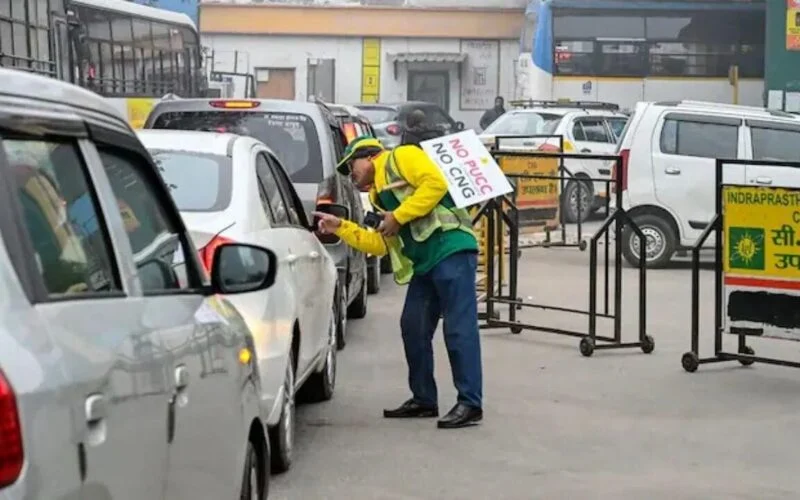
A fuel station attendant checks for a PUC certificate under Delhi's "no PUC, no fuel" rule. Photo via PTC News.
The Union government has rewritten the rules on how long a Pollution Under Control (PUC) certificate stays valid, giving owners of newer BS-VI cars and two-wheelers three years between emission tests while keeping older vehicles on a short leash. The Ministry of Road Transport and Highways (MoRTH) notified the Central Motor Vehicles (Sixteenth Amendment) Rules, 2026, as G.S.R. 991(E), dated 13 November. The rules were published in the Gazette of India on Monday, 16 November, and came into force that day. They replace sub-rule (7) of Rule 115 of the Central Motor Vehicles Rules, 1989, which has governed PUC certificates across the country, and for the first time tie a certificate’s validity to both the vehicle’s emission standard and its age.
The headline change is a relief for owners of recent vehicles. The less-noticed part of the notification is a single national schedule that, in several states, means older vehicles, including many BS-IV cars, will need a fresh certificate more often than before.
What the New PUC Rules Say
The notification sets out validity in a four-row table. Age is counted from the date of first registration, as recorded on the registration certificate (RC), not from the date a current owner bought the vehicle.
Also read Annual Toll Pass for Residents Near Plazas: ₹1,500 From 1 November
| Vehicle category | Age from first registration | PUC certificate validity |
|---|---|---|
| BS-I, BS-II and BS-III (all vehicles) | Any age | Three months |
| BS-IV (all vehicles) | Any age | Six months |
| BS-VI non-transport (private cars, two-wheelers) | Up to six years | Three years |
| Six to 10 years | One year | |
| Over 10 years | Six months | |
| BS-VI transport (taxis, buses, goods vehicles) | Up to six years | Two years |
| Six to 10 years | One year | |
| Over 10 years | Six months |
Two provisos follow the table. A certificate issued before 16 November keeps its existing validity, and the new periods apply only from its first renewal after that date. And the renewal date now has a fixed rule: if an owner renews within 10 days before the certificate expires, the new one runs from the old expiry date, so no days are lost. If the certificate is renewed at any other time after it has lapsed, the new validity runs from the date of renewal.
The notification is signed by Mahmood Ahmed, Additional Secretary in the ministry, and was issued under Section 110 of the Motor Vehicles Act, 1988.
What Has Changed From the Old PUC Rules
Until now, the central rule required every motor vehicle to carry a valid PUC certificate once a year had passed from its first registration. A new vehicle’s first year was covered at the time of sale, and the period of each later certificate was largely set and administered by states. That is why the answer to “how long is my PUC valid?” depended on where a vehicle was registered.
Delhi’s transport department, in public notices reported by PTI, has said that four-wheelers meeting BS-IV norms get a one-year certificate and other vehicles get three months. Insurers’ guides for Delhi list one year for BS-IV and BS-VI vehicles. Reports on the July draft described the national practice differently, with BS-I to BS-IV vehicles on six months and BS-VI vehicles on one year. Coverage of the draft even disagreed on whether the three-month period for the oldest vehicles was new or carried over, a sign of how uneven the old system was.
Set against that patchwork, the new rules change six things.
| Issue | Before 16 November 2026 | From 16 November 2026 |
|---|---|---|
| BS-VI private vehicles, up to six years old | Generally one year | Three years |
| BS-VI transport vehicles, up to six years old | Generally one year | Two years |
| Ageing BS-VI vehicles | No age-based rule | One year from six to 10 years, six months after 10 |
| BS-IV vehicles | Six months to one year, depending on state and vehicle type | Six months everywhere |
| BS-I to BS-III vehicles | Three to six months, depending on state | Three months everywhere |
| Early renewal | No rule on carrying over unused days | Renew within 10 days of expiry and keep the full new period |
The substituted sub-rule also drops the old wording that a certificate was required only “after the expiry of a period of one year” from registration. It now says simply that every vehicle shall carry a valid certificate, with BS-VI validity counted from the date of first registration. The notification does not say who issues the first certificate at the point of sale, which dealers have handled until now.
Who Gains, and Who Will Test More Often
The clearest winners are owners of BS-VI vehicles bought since April 2020, when the standard became mandatory for new vehicles nationwide. A private BS-VI car registered in 2023 can now go three years between tests, and three more after that, before moving to annual checks.
Over a decade, the saving is real but modest. Under a one-year cycle, a car needed roughly 10 certificates in its first 10 years. Under the new schedule, a BS-VI private car needs about six: two three-year certificates covering the first six years, then four annual ones. That is IPB’s arithmetic from the notified table, not a government estimate.
The relief is also shorter-lived than the headline suggests for the earliest BS-VI buyers. A car first registered in April or May 2020 crosses six years in 2026 and moves straight to annual renewal at its next test. Anyone buying a used BS-VI car that is four or five years old should expect the three-year window to close soon after purchase.
The vehicles that may test more often are older ones. Where states issued one-year certificates to BS-IV cars, as Delhi’s transport department has said it does, the national table now sets six months, which would mean two tests a year instead of one. BS-I to BS-III vehicles in states that allowed six months are now on a three-month cycle, or four tests a year. Owners of these vehicles, many of them in smaller towns and on lower incomes, will bear the added cost and time; the notification offers no transition for them beyond the first-renewal proviso.
The Government’s Case for Longer Validity
The ministry’s notification gives no reasons for the schedule beyond stating that public objections were considered. The case made for the July draft rested on the technology. BS-VI vehicles emit up to 82 per cent less particulate matter and about 25 per cent less nitrogen oxides than BS-IV vehicles, according to figures cited in coverage of the proposal. A former joint secretary in the ministry told reporters at the time that the lower emissions of new BS-VI vehicles justified longer validity.
The logic is that a new, well-engineered vehicle is unlikely to fail a basic tailpipe test in its early years, and that annual tests for such vehicles mostly add cost for owners and paperwork for testing centres without catching much. Older engines, whose emission controls wear out, are where tests are more likely to find a problem.
The Case for Caution
Not everyone accepts that age and emission norm alone tell the full story. Anil Chhikara, a former deputy transport commissioner in Delhi, has argued that the government also needs to look at how vehicles are maintained, because even fairly new cars can pollute more when they are poorly looked after.
A three-year gap means a fault in a catalytic converter or a diesel particulate filter, or a tampered emission system, could go undetected for longer than before. The PUC test itself is limited: it is a short idle test at a roadside centre, and its reliability depends on the equipment and honesty of the centre. Delhi is preparing a new system, PUCC 3.0, which is to use artificial intelligence, geotagging and direct data uploads to confirm that a vehicle is physically present and actually tested, a measure aimed at curbing fake certificates. Whether other states follow will decide how much a PUC certificate is worth under the longer validity.
What the Ministry Has Not Explained
The final table is the same as the one published in the July draft. The preamble says the objections and suggestions received from the public “have been considered”, but the ministry has not published how many it received, what they said, or why none led to a change.
Several questions remain open. The ministry has not said how many vehicles move to a longer or a shorter cycle, or what the change means for testing centres whose income depends on renewals. It has not explained how the first certificate for a new BS-VI vehicle is to be issued now that the one-year wording is gone. And it has not said how the national schedule sits with state measures that go further, such as Delhi’s rule, in force since April, that fuel stations must refuse petrol, diesel, CNG and LPG to vehicles without a valid certificate. IPB has reported on how that no PUC, no fuel rule works during Delhi’s winter curbs.
The change also arrives as Delhi-NCR goes through another season of very poor air, with GRAP restrictions in force and vehicle curbs being argued in court, including the Delhi High Court’s exemption for lawyers from a ban on non-BS-VI vehicles. Easing tests for the newest vehicles is defensible on the engineering. Doing it without publishing the evidence or the objections it weighed leaves the ministry open to the charge that convenience, not air quality, set the timetable.
What Vehicle Owners Should Do Now
Check two things on the RC or the VAHAN and mParivahan records: the emission norm (BS-IV, BS-VI and so on) and the date of first registration. Together they decide which row of the table applies.
A certificate already in hand remains valid until its printed expiry date. The new period applies at the next renewal. To avoid losing days, renew in the 10 days before expiry; the new certificate will then start from the old expiry date. Renewing earlier than that is not covered by the carry-over rule.
Driving without a valid certificate remains an offence under Section 190(2) of the Motor Vehicles Act, which since the 2019 amendment carries a fine of up to ₹10,000, possible imprisonment, and disqualification from holding a driving licence for three months. In Delhi, a lapsed certificate can also mean being turned away at the fuel pump. Electric vehicles, which have no exhaust, have not needed PUC certificates, and the notification does not address them.
IPB’s coverage of vehicle pollution rules is collected under the PUC certificate tag.
Source: Gazette of India, Extraordinary, Part II, Section 3(i), No. 885, 16 November 2026: Ministry of Road Transport and Highways notification G.S.R. 991(E), dated 13 November 2026. Draft rules: G.S.R. 664(E), dated 22 July 2026. Also based on reporting by ETV Bharat, Upstox, Deccan Chronicle, Telangana Today, PTI via LatestLY, VahanBazaar and Analytics India Magazine; Delhi Environment Department notification of 22 April 2026.
Image: PTC News.