Gujarat Rooftop Solar Subsidy: State Tops Up PM Surya Ghar Aid
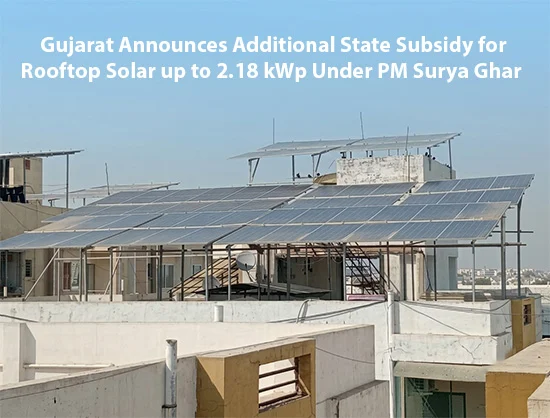
Image: Energetica India
The Gujarat government has approved an extra state subsidy for home rooftop solar systems, on top of the central assistance under PM Surya Ghar: Muft Bijli Yojana. State government spokesperson and minister Jitu Vaghani announced the decision after the Cabinet meeting chaired by Chief Minister Bhupendra Patel on Wednesday, 21 October. According to a government notification reported by Energetica India, the top-up applies to residential systems of up to 2.18 kWp commissioned on or after 22 October.
Households Pay 5% to 10% of Cost
Under the notification, a household pays 10% of the benchmark cost, and Scheduled Caste and Scheduled Tribe households pay 5%. The state meets the rest after the central subsidy is deducted. The benchmark cost is Rs 50,000 per kW for the first 2 kW and Rs 45,000 per kW beyond that.
DeshGujarat reports an example for a 1 kW system costing Rs 54,000: central subsidy of Rs 32,400, state subsidy of Rs 16,200 and a household share of Rs 5,400. For SC and ST families the state pays Rs 18,900 and the household Rs 2,700. The state money goes straight to bank accounts through direct benefit transfer, routed via DGVCL, MGVCL, PGVCL, UGVCL and Torrent Power, with GUVNL as the nodal agency.
Households that already have a smaller system from an earlier scheme can apply for more capacity, as long as the total stays within 2.18 kWp. A beneficiary cannot add more rooftop capacity for three years from installation.
Gujarat Already Leads on Rooftop Solar
DeshGujarat reports that more than 14 lakh Gujarat households have installed rooftop solar, and over 8.5 lakh of them did so under PM Surya Ghar, the highest of any state. The new top-up is expected to cost about Rs 1,000 crore and reach more than 3 lakh households.
Check the Commissioning Date
Because the benefit covers only systems commissioned on or after 22 October, homes whose panels were switched on earlier do not qualify. The reports do not say when the first payments will reach bank accounts, and the two outlets differ on whether the cap is 2 kW or 2.18 kWp, so the notification text will settle the exact limit. More state decisions are on our Daily Updates page.
Source: Based on reporting by Energetica India and DeshGujarat.
Image: Energetica India.