Vibruised egos, radical student groups: Inside story of Karnataka’s hijab crisis
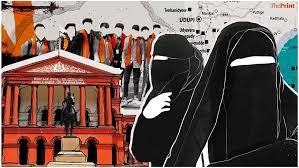
The hijab row that has snowballed in Karnataka is rooted in the communally fraught coastal belt, where radical organisations vie for supremacy.
The hijab row has been making headlines since January, but Shukur claimed the issue was triggered in October when viral photos showed Muslim girls at a protest organised by the Akhil Bharatiya Vidyarthi Parishad (ABVP, the RSS-affiliated students’ body).The images in question were posted on the Facebook page of the Udupi ABVP on 30 October last year. They showed Muslim girls holding the ABVP flag as part of a protest demanding a probe into the alleged rape of a Manipal student. In the communally sensitive coastal belt of Karnataka, the pictures ignited a controversy.“I was taken aback to see my daughter there… because she isn’t a member of ABVP,” Shukur said.
Furthermore, Muskaan was not wearing her usual headscarf in the photo.“I asked her why she wasn’t wearing a headscarf in the photo, and that is when she told me that the college doesn’t allow hijabs in classrooms,” he said. This came as a shock to Shukur, who decided to confront the college principal. According to an intel report submitted by the Udupi police to the state government, the Campus Front of India (CFI), which is the students’ wing of the Islamist outfit Popular Front of India (PFI), had approached parents with the offer to help take on the college management.
A source from the CFI who did not wish to be named told ThePrint that the ABVP protest incident had outraged the organisation. It therefore started encouraging Muslim women to refuse to join ABVP events and to fight for their right to wear hijabs in the classroom. The women’s parents also took these demands to the college.“When I asked the principal why students were being sent to protest without consent and were not allowed to wear headscarves, he said it was a small issue,” Shukur said.
Rudre Gowda, principal of the college, rejected this allegation. “For years, students have been wearing hijabs to campus, but have been removing them during classes. These girls too were adhering to this, but since December, they started demanding that hijab should be allowed during classes too,” Gowda told ThePrint.
The matter quickly led to a standoff between the families of six Muslim students and the college management. The CFI also alleged that the college had, as retaliation, made details of the girls and their families public.
While there were attempts to negotiate an understanding between the students and the college authorities in Udupi, the row escalated rapidly — partly due to political organisations jumping on to the bandwagon and partly due to the wildfire effect of social media.
In January, the students petitioned the Karnataka High Court, by which time the issue was making headlines and had snowballed into communally charged conflicts in several Karnataka colleges.
A senior leader of the Udupi District Muslim Okkoota — an umbrella organisation of mosques, jamaats, and Islamic organisations in Udupi — told ThePrint on the condition of anonymity that the body had tried its best to convince the families that it was acceptable to remove the hijab in class.
“We advised the girls to not make a big issue out of not wearing hijab inside classrooms. We even took them and their parents to religious clerics and explained that it was okay to remove hijabs in the classroom,” he said.
However, the students were “adamant”, he said, because they had received backing from the CFI, the campus affiliate of the PFI, an Islamist outfit that was set up in Kerala in 2006 and which the Bharatiya Janata Party (BJP) wants banned because of its allegedly radical tendencies.“The CFI saw [the hijab conflict] as an opportunity to strengthen its support base,” the Muslim Okkoota leader said. In coastal Karnataka, he explained, the two main students’ bodies are the ABVP and CFI, while the Congress’s campus body, the National Students Union of India (NSUI), does not have a presence in local colleges.
By the end of December, though, nobody was in the mood for a compromise, according to the Muslim Okkoota leader. He said that the Muslim women’s protest, and the social media traction it got, riled the College Development Committee (CDC), which is empowered by the government to take administrative decisions for public educational institutions.“In December and January, the students’ protests started getting attention on social media and the press. They were shown standing outside the classroom and making notes since they were not allowed inside. This hurt the egos of the committee members,” he claimed, adding that the senior-most members of this body were members of the BJP and RSS. None of the 21 members in the CDC are from the Muslim community.
The matter had now become a “prestige issue” with the BJP and other Hindutva organisations on one side, and the PFI and its affiliates on the other, the Muslim Okkoota leader said.“Within two days of the girls’ protest in January outside their classrooms, thousands of social media posts were released. How is that possible without a pre-planned, strategised effort?” V. Sunil Kumar, Minister for Energy and Kannada & Culture, told.“When [Muslim students] started escalating the matter, naturally, students from the Hindu community retaliated — a matter of action and reaction,” Kumar, who is also the MLA from Karkala in Udupi district, added.
The PFI has denied such allegations and has attempted to distance itself from the row.“As an organisation, we are working for upliftment of marginalised communities. We are in no way involved in this row. Our student wing (CFI) is only trying to provide moral support to aggrieved students. Communal flareups only benefit the BJP,” Anis Ahmed, national general secretary of the PFI, told ThePrint.
The CFI has acknowledged that it was helping the Muslim women’s agitation in Udupi’s PU College, but denied having any political motives.“We are a student organisation. We do not have any links with political parties. We are leading the students who are fighting for their rights. Muslim students have been harassed at that institute for years now. This is not a retort that erupted overnight,” Masood Manna, a committee member of CFI Udupi, told.In 2010, the political wing of the PFI — the Social Democratic Party of India (SDPI) — was registered with the Election Commission. Since then, it has slowly been making inroads in the coastal Karnataka belt. It had one of its biggest triumphs in the December 2021 elections to 58 Urban Local Bodies (ULBs) in Karnataka, when it won six seats.
Notably, some Muslim community leaders also have reservations about the PFI and its branches. The senior Muslim Okkoota leader who was quoted earlier alleged that the hijab protests seemed to be a ploy by the organisation’s political wing to mobilise support. “All the Muslim girls use the same vocabulary… ‘fundamental rights’, ‘constitutional issue’, ‘hijab is intrinsic to Islam’. While they may have been wearing hijab for years, the words and phrases that are being publicly said are coming from one source,” the Muslim Okkuta leader claimed.Allegations of “instigation”, however, have also been levelled against Hindutva organisations, which have started a counter-agitation involving saffron shawls and scarves, and an influx into colleges of ‘protesters’ who are not even students.“Perhaps one or two Muslim girls used to wear hijab to college but now the number has drastically increased. They are doing this to assert their religious identity,” Halady Srinivas Poojari, MLA for Kundapur, told ThePrint.
He isn’t far off the mark, although there are varying interpretations of why exactly the women are doing so.
According to Abdul Aziz Udyavar, organising secretary of the Udupi District Muslim Okkoota, the fight over the right to wear the hijab has inspired other girls from the community to exercise their constitutionally guaranteed freedoms. “Just because I was not exercising my right before doesn’t mean I shouldn’t do it in the future,” Udyavar said.
Principals of at least three colleges in Kundapur told that while some Muslim students had always worn the hijab to classes, the number had increased ever since the row took off in January.“There is no explicit rule that bans hijab in the college, but there is no rule that permits it either,” Naveen Shetty, principal of R.N. Shetty College, said.
According to him, students who sought permission to wear hijabs earlier could usually do so “as long as it doesn’t cause trouble”. Now, Shetty said, it was causing trouble and so hijabs as well as saffron scarves were banned in the college. “The management decided to ban both explicitly until the time the high court order comes,” Shetty added.
The Muslim Okkoota had until recently refrained from openly backing the hijab cause but has now reconsidered its decision. “When Muslim girls who are studying at co-ed colleges that have allowed hijab for years started getting targeted, we had to step in since it is injustice being meted out to them,” Ibrahim Sahib Kota, president of the Udupi Muslim Okkoota, said.
Another protestor, Akshat Pai, said he had graduated from the college in 2014, but was there in his capacity as a Hindu Jagaran Vedike leader. “We haven’t pressured the students into protesting. They are doing it on their own,” Akshat Pai said, as students in saffron accessories hovered around him and asked whether they should leave or stay.
Harshita, another Hindu student at MGM college, had a different viewpoint. She cited a 5 February government order proscribing clothes that “disturb public law and order” and said that if Muslim women could wear hijabs, Hindus could wear saffron scarves.
Prakash Kukkehalli, Mangaluru unit general secretary of the Hindu Jagaran Vedike, was observing the protest at MGM college from the other side of the road, with young men from the campus occasionally arriving to consult with him.
Over the past few days, though, the protests have taken a more violent turn. The police arrested 15 people in Shivamogga and Bagalkot districts Tuesday. Last week, police in Kundapur, Udupi, arrested two people, Abdul Majeed and Rajab, who were carrying knives near Kundapur Government PU College.Communally sensitive belt of Karnataka.
The three districts of coastal Karnataka — Dakshin Kannada, Uttar Kannada, and Udupi —are often counted among the more communally sensitive regions in India. All three districts have a sizeable population of Muslims as well as Christians.
Social activists attribute the frequent communal flare-ups in the region, which is frequently described as a “Hindutva laboratory“, largely to incitement from radical Hindu and Muslim organisations.
Updated by Divya Mangulam